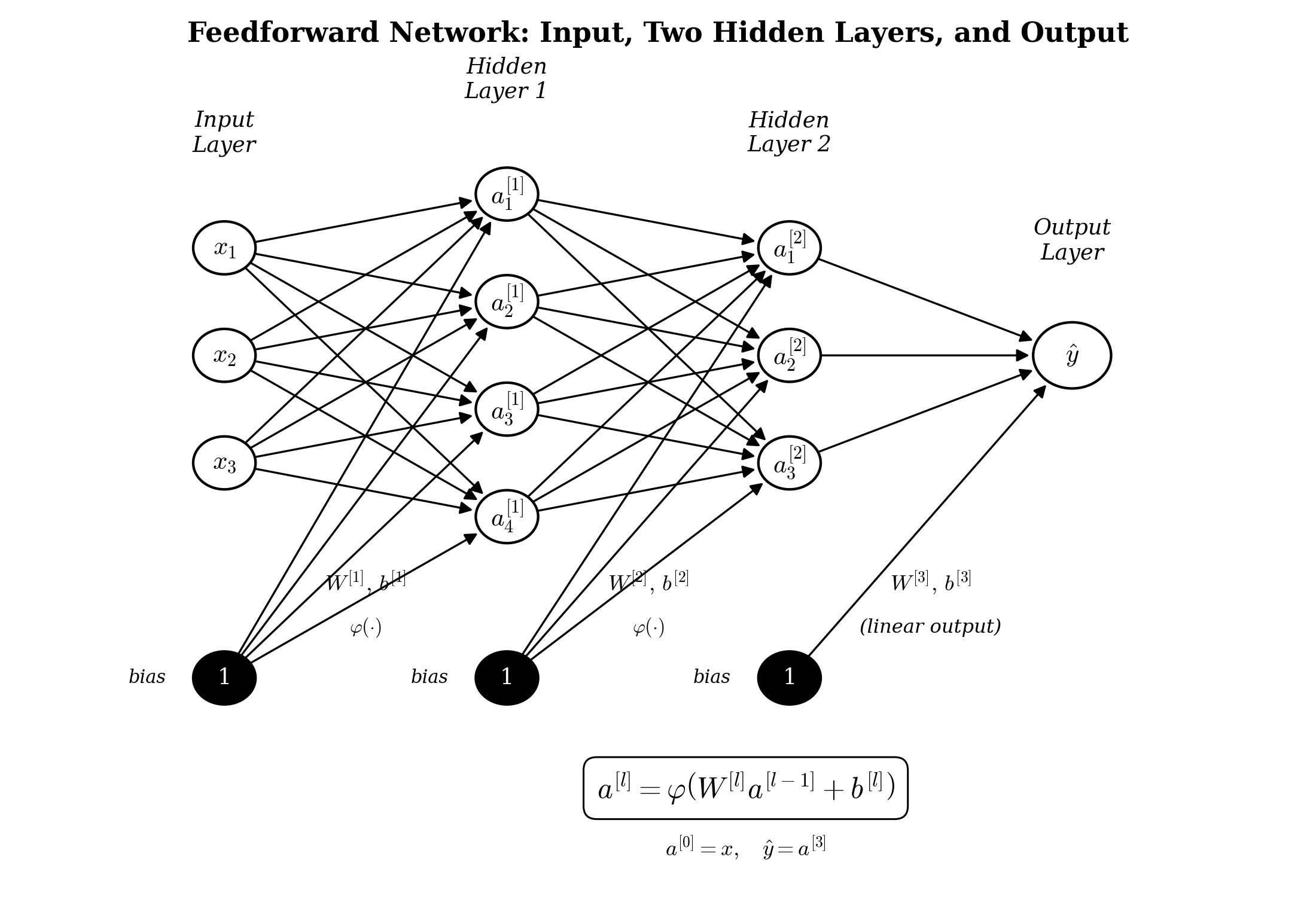
I've spent about 25 years building marketing mix models — regressing sales on advertising to hand a brand a return-on-investment number and a response curve. Lately I've been writing a paper comparing that traditional approach to a deep learning one, and the diagram above is straight out of it.
A regression is just a network with one neuron
That's the trick that made the rest of this click for me. A classic marketing mix regression — sales as a function of a marketing driver, with an intercept and a slope — is mathematically identical to a single-node network: inputs, weights, a bias, and an output. Nothing new, just a different way of drawing the same equation.
Add depth, and it stops being linear
The diagram here takes that single neuron and stacks it: an input layer feeding two hidden layers, each with its own weights and biases, into a single output. The piece that actually matters is the activation function between layers. Without it, stacking layers is pointless — compose enough linear functions and you still just have a linear function. With it, the network can learn the kind of non-linear, high-interaction response curve that a traditional model has to assume the shape of before it even sees the data.
Old models assume the shape; new ones find it
Traditional response modeling works fine, but it's built on datasets of a few thousand rows and a handful of variables, with a response curve shape chosen in advance. That was a reasonable compromise when data was scarce. It's less reasonable now that datasets of millions or billions of rows are routine. More data is exactly what a deep model needs to stop assuming and start empirically finding the response curve instead.
There's a lot more in the paper about where traditional response modeling quietly goes wrong — collinearity, priors that turn into the analyst's expectations rather than the data's — but this diagram is the part I keep coming back to. It's the bridge between the model I've built my career on and the one I think replaces it.
The transformer version: a model you can talk to
A recent paper by Thomas Mulc, et al. (2025) pushes this further, applying the transformer architecture to response modeling. The takeaway: combine big data with a model carrying hundreds of thousands — sometimes millions — of parameters, instead of the dozen or so in a typical response model, and the model stops being something you fit once and read off. It becomes something you interrogate, the same way you'd query an LLM. Training is computationally demanding, but once it's built, an analyst can just ask it questions:
- What was the return on investment for marketing executed in the third quarter?
- What was the impact of the competitive launch in Q2 — did it hurt our sales, and if so, where?
- Which campaigns are performing best this month?
That's a genuinely exciting shift. It's the promise response modeling has always had — a real, empirical read on marketing performance — finally backed by data and model capacity large enough to deliver on it. The paper is worth a read.
Final word: watch this space closely. I think we're going to see some revolutionary changes coming out of the combination of big data and deep learning models.